ABA Therapy and School Collaboration: How the IEP and Your Child’s Support Team Work Together
If you are trying to make sense of school services, home-based ABA, and everyday concerns like communication, transitions, or behavior, you are not alone. A lot of parents in North Carolina end up holding all the moving pieces at once. The good news is that your child’s ABA team and school team do not need to do the same job to work toward the same progress.
ABA therapy and school collaboration work best when they support the same child outcomes without blurring roles. The school remains responsible for the IEP, classroom support, and school-based services. ABA can help your child build and carry over skills in ways that complement what happens at school.
Quick Summary
- The IEP outlines what the school is responsible for during the school day.
- Private ABA can support communication, regulation, transitions, independence, and behavior without replacing school services.
- The strongest collaboration usually centers on a few shared priorities, not identical plans.
- Parents often help connect the BCBA, RBT, teachers, and other school staff.
- Short, practical communication usually works better than frequent, detailed updates.
- If you want a better sense of how in-home therapy, parent support, and school collaboration can fit together, Galaxy ABA’s services offer a helpful overview.
Under IDEA, the school team owns the IEP and the supports tied to it. A private ABA team can still play an important role by helping your child practice useful skills, share insight, and build consistency across settings.
What the IEP Covers and What ABA Supports
Your child’s IEP covers what the school is responsible for providing so your child can access their education. That may include instruction, accommodations, related services, and school-based behavior support.
Private ABA is different. It is a separate clinical service that can support skill-building, behavior strategies, parent coaching, and carryover across home and school. That distinction matters because it helps families understand where collaboration is useful and where duplication starts.
For example, both the school and ABA team may care about smoother transitions or better communication. That overlap is not a problem on its own. The problem would be expecting an outside ABA provider to take over classroom instruction, direct the IEP, or replace school responsibilities.
A better way to think about it is this: the school owns the education plan, and ABA can support the child skills that help that plan work better in real life. If you want to understand how that broader support model can look, Galaxy ABA’s service approach explains how school collaboration fits alongside in-home care and parent guidance.
The Alongside Support Map
When families feel pulled between school recommendations and therapy recommendations, it helps to have a simple way to sort out who does what. The Alongside Support Map keeps the focus on role clarity, shared priorities, carryover, manageable communication, and real progress.
Role Boundaries
The school team usually owns IEP implementation, classroom accommodations, instruction, and school-based behavior supports. That can include input from special education teachers, general education teachers, school psychologists, and anyone else involved in the child’s school plan.
The ABA team plays a different role. A BCBA may help identify behavior patterns, suggest strategies, coach parents, and build goals around communication, regulation, independence, or transitions. An RBT may help carry out the therapy plan under BCBA supervision.
Parents are often the bridge between both teams. That does not mean you have to manage everything alone. It simply means your perspective helps keep everyone focused on the same child outcomes.
The clearest collaboration happens when each team stays in its lane while still sharing useful information.
Shared Goal Match
School and ABA goals do not need to be written the same way to work together. What matters is whether they support the same larger outcome.
A school goal might focus on staying engaged during classroom routines. An ABA goal might focus on asking for help, tolerating changes, or moving through transitions with less distress. Those are not identical goals, but they can support the same day-to-day progress.
For school-age children, shared priorities often include:
- communication
- transitions
- self-regulation
- peer interaction
- independence with routines
Keeping the focus on two or three meaningful outcomes usually works better than trying to align everything at once.
Carryover Plan
This is where collaboration becomes practical. Carryover does not mean teachers are expected to run therapy in the classroom. It means your child benefits from some consistency when a strategy is already helping.
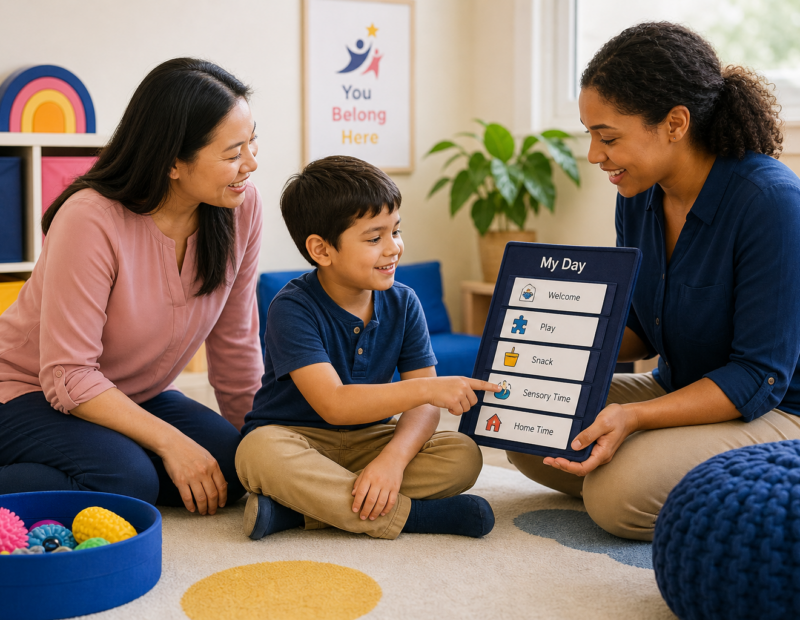
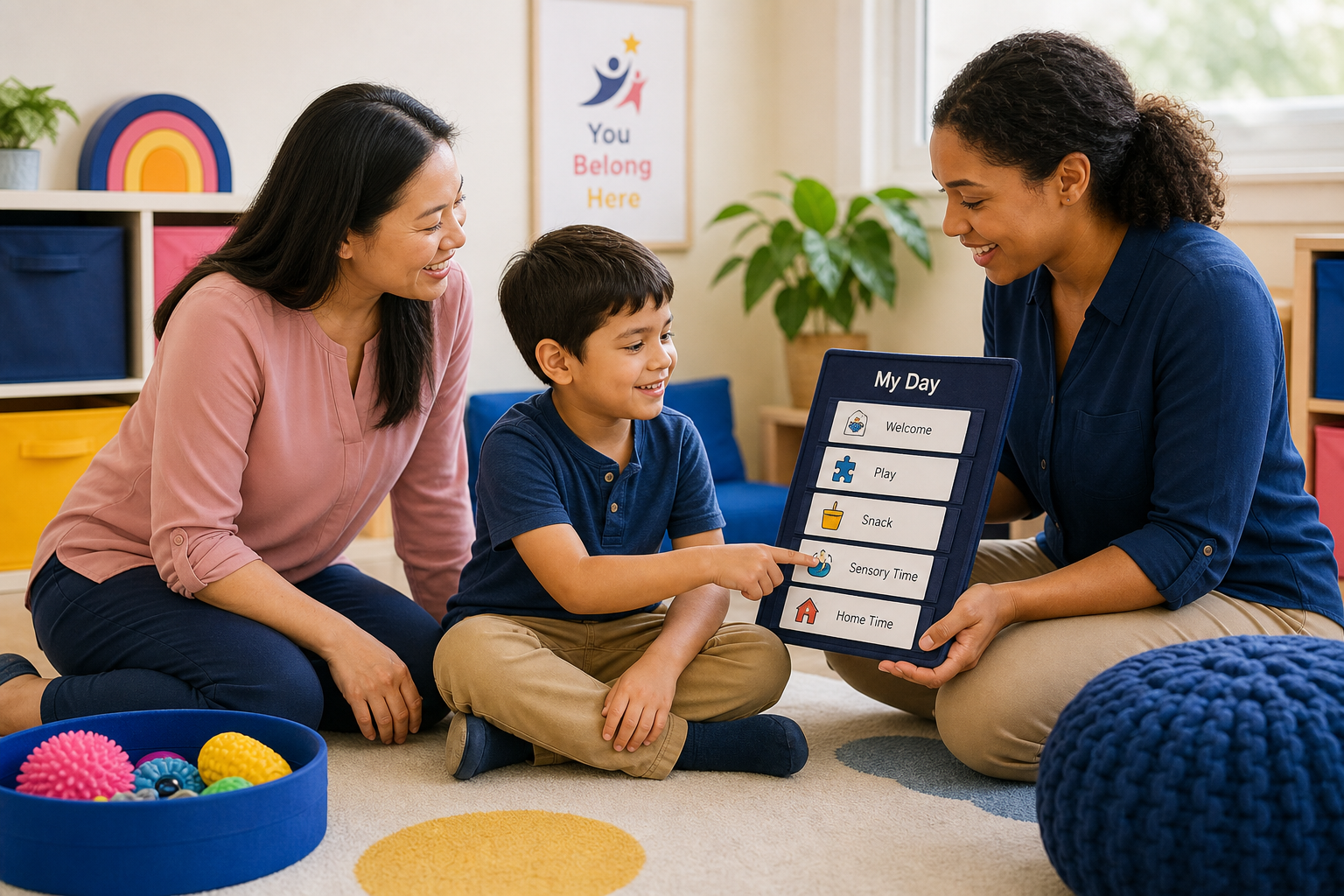
If your child responds well to a visual schedule at home, the school team may decide a similar support makes sense during classroom transitions. If your child is learning to ask for a break instead of leaving the area, both teams may reinforce that skill in ways that fit their own settings.
The goal is not sameness. The goal is familiarity. When the adults around your child are reinforcing helpful skills in connected ways, progress often feels steadier and less fragmented.
Communication Rhythm
Good collaboration does not require constant communication. It requires useful communication.
Before anything is shared, families should understand consent and privacy boundaries. Once that is clear, many teams do best with short, focused updates rather than long back-and-forth messages.
A quick weekly check-in, a short written summary before a meeting, or a focused update around one concern is often enough. The most helpful communication usually answers simple questions like:
- What skill or concern is the priority right now?
- What strategy seems to be helping?
- What changes are showing up across settings?
That kind of communication is easier to sustain and more helpful than sending every detail.
Review Point
The best way to tell whether collaboration is working is to look for concrete changes over the next four to six weeks.
Is your child asking for help more often? Moving through transitions with less distress? Participating in routines more consistently? Showing more follow-through with a communication strategy that both teams are supporting?
If the answer is no, the next step usually is not adding more overlap. It is stepping back to clarify roles, tighten the shared priorities, and make sure everyone is working toward something specific and realistic.
What Collaboration Looks Like in Real Life
In real life, ABA therapy and school collaboration usually works best as a simple sequence rather than a complicated system.
First, clarify consent and information sharing. Parents can confirm whether the school may speak with the BCBA, what information can be shared, and what type of outside input is appropriate.
Second, identify the shared priorities. That might be difficulty with transitions, trouble asking for help, escalation during unexpected changes, or trouble following a classroom routine.
Third, match strategies across settings when it makes sense. If a child in Charlotte is using a visual schedule successfully during home ABA, the school may decide a similar support could help during arrival or transitions. If a child in the Raleigh-Durham area is working on asking for help before becoming overwhelmed, the teacher and ABA team may reinforce that same communication skill in different but compatible ways.
Fourth, agree on a communication rhythm. That could look like a short parent-mediated update each week, a BCBA summary before an IEP meeting, or a focused check-in when a behavior plan is being reviewed.
Fifth, review progress. If a school FBA points to patterns around transitions or escape behavior, ABA observations may help parents ask more targeted questions about triggers, consistency, and reinforcement. The school still owns the school-based plan. The ABA team can contribute insight, but it does not take control of the IEP or BIP.
If your family is looking for a provider that supports progress across home and school, Galaxy ABA’s services give a clearer picture of how that kind of coordinated support can work.
Common Misunderstandings That Lead to Duplication
A lot of frustration starts with role confusion. These are some of the most common misunderstandings parents run into.
“If ABA helps, the school should just do the exact same thing.”
Not necessarily. The school and ABA team may support similar outcomes, but they are working under different responsibilities and in different environments.
“If my child has private ABA, the school does not need to address the concern.”
School responsibilities do not disappear because a child receives outside services.
“ABA can be written directly into the IEP as the school’s solution.”
Schools may consider outside input, but that is different from making a private ABA provider the school’s service model.
“An ABA therapist can always attend an IEP meeting.”
Sometimes outside providers attend, submit written input, or speak with parent permission. Sometimes schools structure that involvement differently or limit participation.
“If both teams use similar strategies, that means services are being duplicated.”
Not always. Duplication happens when one team starts doing the other team’s job. Reinforcing a shared skill in different settings is usually coordination, not duplication.
ABA + IEP Team Alignment Checklist
If you have an IEP meeting, teacher conference, or ABA review coming up, this checklist can help you walk in with a clearer plan.
Before the meeting
- Write down your child’s biggest school-day concerns.
- Gather recent teacher feedback and your own observations.
- List the questions you want answered.
Role clarity
- Identify what the school team owns within the IEP and classroom plan.
- Note what the ABA team is already addressing.
- Clarify who can share input, observe, or attend meetings.
Shared goals
- Choose two to three outcomes to reinforce across settings.
- Note which IEP goals connect to communication, behavior, transitions, or participation.
- Keep those goals specific enough that progress is easy to recognize.
Communication plan
- Decide what updates actually need to be shared.
- Agree on how often communication should happen.
- Confirm any consent or privacy steps before information is exchanged.
Progress review
- Define what success should look like over the next four to six weeks.
- Watch for signs that roles are getting blurred or the plan is too vague.
- Revisit the shared priorities if progress is limited.
What North Carolina Parents Should Expect When Teams Coordinate
For North Carolina families, one of the biggest things to expect is variation. District practices, school permission rules, and comfort with outside-provider involvement can differ from one school system to another.
One family in Charlotte may find that the school is open to brief outside-provider input before an IEP meeting. A family in the Triangle may be asked to route communication through school staff or written documentation instead. That difference often reflects local process, not a lack of care.
It can help to ask practical questions such as:
- Who can receive outside input?
- Are written recommendations preferred?
- How are school behavior concerns reviewed?
- What is the best communication channel for keeping everyone aligned?
If you are also thinking about next steps with providers, Galaxy ABA’s services and this guide to choosing an in-home ABA provider in Charlotte can give you more context.
FAQ
Can an ABA therapist attend an IEP meeting?
Sometimes, yes. It often depends on school policies, parent consent, and how the meeting is structured. In some situations, an outside ABA provider may attend directly. In others, the school may prefer written input or more limited participation.
How does ABA therapy align with IEP goals without replacing school services?
ABA aligns with IEP goals when both teams support the same child outcome while keeping different responsibilities. For example, the school may focus on classroom participation during instruction while the ABA team helps the child practice asking for help or tolerating transitions across settings.
What is the difference between school services and private ABA therapy?
School services are what the school is responsible for providing so a child can access their education under the IEP. Private ABA therapy is a separate clinical service that supports skill-building, behavior strategies, parent coaching, and generalization across settings.
How can teachers and ABA therapists share progress without duplicating services?
The most helpful updates are short and practical. Focus on the child’s current priority, the strategy being used, and what changes are showing up in real situations. The goal is coordination around outcomes, not identical service delivery.
How can parents help the school team and ABA team stay aligned?
Parents often help most by narrowing the focus. Choose the few concerns that matter most right now, ask each team what role it can realistically play, and then revisit whether the plan is leading to visible change.
If you are trying to build a support plan that feels coordinated instead of fragmented, Galaxy ABA can help you understand how in-home therapy, parent coaching, and school collaboration may fit together. Explore Galaxy ABA’s services to learn more.